Course Design & AI Education: D685, Practical Applications of Prompt Engineering, Western Governors University
Subject Matter Expert & Co-Architect
The Problem
When generative AI use exploded, universities faced a real gap: students needed to learn how to actually use these tools well, but most available coursework treated prompt engineering as a purely technical skill, how to phrase a request, rather than a responsibility, what happens once the AI responds. Without a structured way to teach responsible use alongside the technical skill, there was a real risk of producing students who were fluent with AI but had never been asked to think critically about fairness, accountability, safety, transparency, privacy, or the broader impact of the systems they were using.
Why It Matters
Western Governors University recognized that gap early and moved to build one of the first undergraduate courses focused specifically on practical AI use. Getting it right mattered beyond the course itself. Done well, it could become a model for how competency-based education teaches AI literacy responsibly. Done poorly, it risked either overwhelming students with abstract ethics content disconnected from real use, or skipping responsible use altogether in favor of pure technical skill.
My Role
I served as subject matter expert and co-architect on the course, D685: Practical Applications of Prompt Engineering, responsible for the course's design from the ground up, not just reviewing content someone else had already built.
What I Built
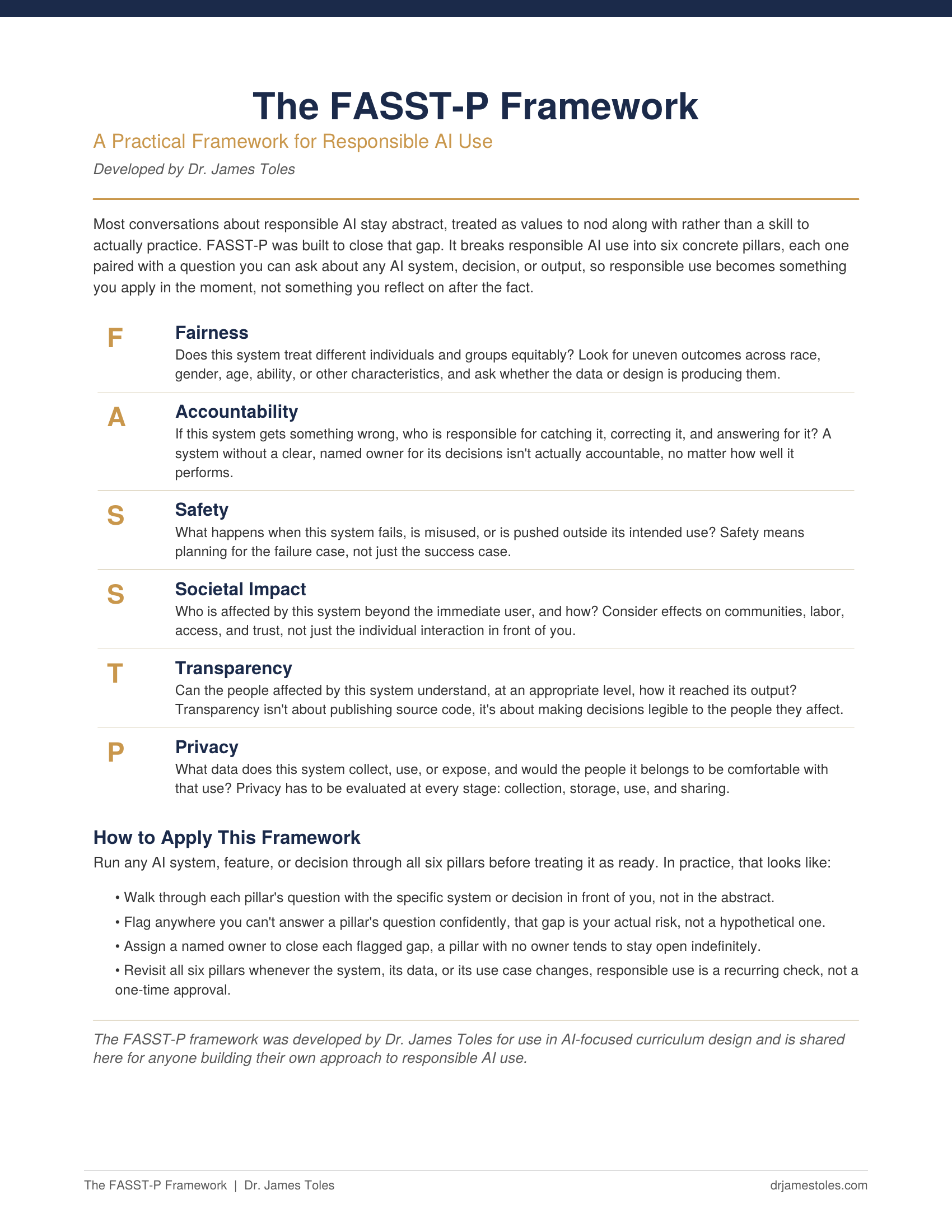
To close the gap between technical skill and responsible use, I developed the FASST-P framework, Fairness, Accountability, Safety, Societal Impact, Transparency, and Privacy, giving students a concrete, repeatable way to evaluate any AI interaction rather than treating ethics as a one-time lecture topic. Beyond the framework itself, I built the course's full student study guide, helped with the design of the quiz and final exam, and created a 52-question review game to reinforce key concepts before students reached graded assessments. I mapped course content to outside learning resources so students had more than one path to understanding a concept, built the course's student-facing website, and created structured intervention plans instructors could use to reach struggling students consistently and early. Part of the role also meant quality control, catching and correcting errors in course materials before they reached students, including a mischaracterized definition of a foundational prompt engineering technique.
The Outcome
D685 is now one of WGU's flagship AI-focused undergraduate courses, reaching thousands of students at any given time. The FASST-P framework built for it has become the backbone of how the course teaches responsible AI use, giving students a practical habit they can carry into any AI interaction, not just a set of principles they memorize and forget.